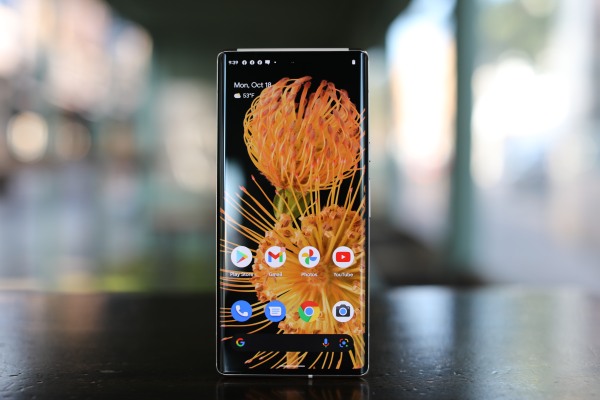
May of 2020 marked the end of an era for the Pixel. Google’s team lost a few key players, as it looked forward toward a transformative future. Understandably so. The Pixel has never been bad a phone (though it’s had some struggles through the years), so much as an unremarkable one. But in an era when it’s hard to buy a bad flagship smartphone, pretty good is not good enough.
Google’s attempts to differentiate themselves from the Apples and Samsungs of the world have largely come up short. The company has had decent success with its budget range A-Series, but dreams of going head-to-head with premium manufacturers have thus far fallen short. Last year’s Pixel 5 wasn’t the departure fans had hoped for, because revamping a product line takes time.
Image Credits: Brian Heater
The company gave us our first glimpse of the device back in August. It was a surprisingly complete look at a device it would take another three and a half months to announce. Hardware head Rick Osterloh primarily focused on chips, design and the fact that Google was becoming the latest company to buck its reliance on Qualcomm by building its own in-house chip, Tensor.
“AI is the future of our innovation work, but the problem is we’ve run into computing limitations that prevented us from fully pursuing our mission,” the executive wrote. “So we set about building a technology platform built for mobile that enabled us to bring our most innovative AI and machine learning (ML) to our Pixel users. We set out to make our own System on a Chip (SoC) to power Pixel 6. And now, years later, it’s almost here.”
Image Credits: Google (opens in a new window) (Image has been modified)
The Pixel 6 sports a 6.4-inch FHD+ OLED at 411 ppi – that bit, at least, is keeping with mid-range specs. The Pro bumps it up to a 6.7-inch QHD+ at 512 ppi. Those displays have refresh rates of 90 and 120 Hz, respectively, protected by a Gorilla Glass Victus cover, which curves on the edges.
Image Credits: Brian Heater
Look no further than the setup on the new Pixels. The 6 supports two lenses: a 50-megapixel wide-angle camera and 12-megapixel on the 6, plus a 48 megapixel telephoto on the 6 Pro. That last one does 4x optical or up to 20x Super Res, though even with computational photography, things are going to degrade pretty quickly. The front-facing camera, meanwhile, is eight megapixels on the 6 and 11 megapixels on the 6 Pro, with 84- and 94-degree fields of view, respectively.
Image Credits: Brian Heater
- Magic Eraser
- Motion Mode
- Real Tone
- Face Unblur
- Panorama
- Manual white balancing Locked Folder
- Night Sight
- Top Shot
- Portrait Mode
- Portrait Light
- Super Res Zoom Motion autofocus Frequent Faces
- Dual exposure controls Live HDR+
- Cinematic Pan
Image Credits: Brian Heater
Material You explores a more humanistic approach to design. One that celebrates the tension between design sensibility and personal preference, and does not shy away from emotion. Without compromising the functional foundations of our apps, Material You seeks to create designs that are personal for every style, accessible for every need, alive and adaptive for every screen.Also new is Calling Assistance, a new feature, which, much like Duplex, is designed to ease the interaction between human and robot operators. Here, it offers projected call wait times for toll free numbers, based on day and time. Direct My Call, meanwhile, uses Google’s transcription feature to display text versions of audio menus that direct to the dial pad. Hold For Me, meanwhile, will wait on the call and notify you when a human picks up.
There’s also improved Assistant Voice typing. Saying, “Hey Google, Type” will use Assistant to dictate text. “Stop” turns the feature off, and “Send” fires off a message. You can also spell out difficult words, letter by letter and dictate emojis.
Image Credits: Brian Heater
Image Credits: Brian Heater